Monday, 13 June 2016
We've moved!
This lovely blog has now been incorporated into a gorgeous new website, so please take a look and follow me here - http://www.joyskipper.co.uk/online-journal/


Wednesday, 18 May 2016
Fun Fermenting!

One of the workshops I attended was 'Gather, Ferment, Flame' where Matthew Pennington from The Ethicurean and Gill Mellor from River Cottage cooked some fun dishes using foods they had gathered, or were produced locally. The great thing was the lack of facilities (they were using a camping stove!) which was perfect for showing just how simple cooking can and should be.
It certainly is a great time for foraging, and on my return I was out in the Chiltern hills, basket in hand and returned home to make a delicious citrus nettle pesto.
But the fermenting demo got me all fired up again, as I love the idea that eating something really tasty is also going to help feed your gut with healthy bacteria. There are lots of fermented foods you can try and if you need inspiration take a look at 'Fermented' by Charlotte Pike.
The recipe below is for a Korean pickle called kimchi, which is served with almost everything in Korea! It can be quite spicy and hot, so once you've made it and know how much heat and spice you can stand you can then change it to suit your taste. Kimchi is made by lacto-fermentation, so no vinegar is used.
Kimchi

Makes approx 1 kg
1 large Chinese cabbage, thickly sliced
200g radish, thinly sliced
1 banana shallot, peeled and thinly sliced
40g sea salt
50g fresh ginger, peeled
50g garlic, peeled
2 tbsp Thai fish sauce
2 tsp chilli flakes (you can add more if wished)
3 tsp sugar
- Place the cabbage, radish and shallot into a bowl with the salt and rub the salt into the vegetables.
- Pour in 1-2 litres of water so the vegetables are covered, then leave to stand for 4 hours.
- Meanwhile, place the ginger and garlic in a small blender and blend until well broken down. Add the fish sauce, chilli flakes and sugar and blend again.
- Drain the vegetables, retaining some of the brine. Pack the vegetables into sterilised jars (you can do this simply by placing them in a cool oven for 20 minutes), then pour in enough brine to cover by about 1 cm.
- Cover loosely and leave to stand at room temperature for 1-5 days, pressing the vegetables down below the liquid each day with a metal spoon.
- After this time taste the kimchi and when it's the flavour and strength you like, place it somewhere cold. It will keep for 4-6 weeks.
Saturday, 16 April 2016
More Questions than Answers?

There were lots of scientific bits, with research that backed up their theories, then lots that had absolutely no scientific evidence to support it at all (such as sitting down on the floor and standing up again with your legs crossed, not using any other part of the body, as a sign that you are likely to live longer), very disappointing. A yoga instructor called into Radio 4 the following morning when this very item was being discussed, and pointed out that to attempt this was likely to cause injury - ankles and knees not being in line apparently.
Then there were the pieces that related to food - Angela was shocked to find she has visceral fat around her organs, but she was going to get rid of it by taking inulin every day (not a pile of old lentils, but just a teaspoon of powder) - no explanation as to what it is, what is does or how you may be able to get it from other foods?
Inulin is a dietary fiber, a naturally occurring oligosaccharide (several simple sugars linked together) belonging to a group of carbohydrates called fructans. Unlike other carbohydrates, inulin is non-digestible, so it passes through the small intestine, and ferments in the large intestine. Through this fermentation process it becomes healthy intestinal micro flora and acts as a prebiotic, feeding probiotics (friendly bacteria) in the gut. In addition to promoting a healthy gastrointestinal tract, inulin may also help with constipation.
Chicory root is the best source of inulin, but there are lots of other foods containing inulin that are easier to include in our everyday diets - leeks, garlic, onions, asparagus, bananas, wheat, Jerusalem artichokes and dandelion root.
For the brain we were told that purple foods would be beneficial, having studied a group of centenarians in the Far East. Again, there was no mention of other aspects of their lifestyle (they were shown playing croquet and whizzing around on a scooter), or other aspects of their diet. I expect the supermarkets are now being inundated with requests for purple sweet potatoes!
Anthocyanins are members of the flavonoid family of phytochemicals, found in plant foods. They provide the bright red-orange to blue-violet colours found in many fruits and vegetables - blackcurrants, blackberries, blueberries, red cabbage, elderberries, cherries, purple grapes, blood oranges and aubergines especially.
Plants produce anthocyanins as a protective mechanism against environmental stressors, such as ultraviolet light, cold temperatures, and drought. This production of anthocyanins in roots, stems, and especially leaf tissues is believed to provide resistance against these environmental hazards, making them a potent antioxidant. Research has shown anthocyanins may have a beneficial effect against cardiovascular disease, cognitive function and cancer.
To increase your intake of both nutrients, try these delicious low sugar muffins - perfect for a breakfast or brunch snack. They are also dairy-free. If you can find purple sweet potatoes great, if not orange ones are also fine in this recipe.
Banana and Blueberry Muffins

Makes 12
1 banana, peeled and chopped
4 eggs
100g light muscovado sugar
150ml olive oil
200g wholemeal self-raising flour
1 tsp ground cinnamon
175g carrots, peeled and grated
160g sweet potato, peeled and grated
150g blueberries
- Pre-heat the oven to 190°C / Gas mark 5. Line a muffin tin with 12 paper cases.
- Mash the banana in a large bowl then whisk in the eggs and sugar.
- Slowly whisk in the oil.
- Fold in the remaining ingredients (do not over-mix).
- Divide between the paper cases and bake for 30-35 minutes, until risen and golden.
- Cool on a rack and store in a air-tight container - these also freeze well.
Thursday, 7 April 2016
Cycling Curious Cuba

In Havana we hunted down what was reported to be the best supermarket in the city (and reported by Lonely Planet as stocking everything from fresh pastries to babies nappies) - when we visited there was only spam (found everywhere in Cuba!), mayonnaise, shampoo and obviously, rum!
So not only can you not get a variety of food in hotels or restaurants, it's also impossible to buy it to cook for yourself.
I had assumed that when we reached the countryside we would see more of local people growing their own vegetables and fruits, but this was not the case either, although people we spoke to who were staying in local homes said they had experienced some great food.
One thing that the Cubans do very well is Pina Colada! The best we had was from a shack (known as the service station!) on a main road - we stopped there around 10.30am and instantly joined the long queue. I had intended to have mine without rum, but when they hand you the Pina Colada in one hand and a bottle of rum in the other, it seemed rude not to mix the two!
Another drink that became a favourite when we were cycling long distances on hot days was homemade lemonade - served ice cold, with a layer of honey in the bottom of the glass to be stirred in or not, depending on your likeness for sweetness. I've had this a few times since my return - once while I was suffering with flu (but without the ice!), as I love the mix of sharpness and sweetness that it gives.
Cuban Lemonade

1 lemon, roughly chopped
1/2 tsp sugar
2-3 tsp good flavoured honey
Place the lemon and sugar in a small blender and blend with 100ml water.
Strain into a jug of ice and then strain again into another jug and top up with another 100ml water.
Spoon the honey into a glass and then pour the lemonade on top.
Stir as you drink!
PS. I haven't actually tried it, but I suspect rum would also work quite well in this!
Wednesday, 18 November 2015
A New Grain?

Firstly, it was pretty tough from the point of being at a higher altitude than normal (Gondar is at an altitude of 7,300 ft - and from there we climbed higher) then, having decided to climb to the fourth highest peak in Africa (Ras Dashen at 14,928 ft) we also camped along the way, so no home comforts (or anything close!). But the most difficult thing for me was coming to terms with the poverty that we came across along the way - it was worse than anything I have experienced in any other place I've visited (and I've been to a lot of third world countries), but still the people are smiling - how do they do that? For anybody that is not satisfied with their life back here in the UK, go and spend a few weeks in Ethiopia, and realise how lucky you are.
Apart from the poverty, the area I spent time in was stunningly beautiful - the Simien Mountains are a UNESCO World Heritage site and it's easy to see why - you can sit on the top of a mountain, surrounded by beautiful tame baboons, watch ibex grazing (the only place in the world where you will find this amazing animal) and listen to the black kites making their calls as they fly overhead. All this, and just mountains as far as the eye can see.
As usual, for me it was also a chance to see what food the Ethiopians live on, and it turns out that they have a fantastic crop that they have been growing for years - a grain that is gluten-free and richer in nutrients than most other grains.
Tef, which is available in the UK but at the moment doesn't seem to be that well known, is rich in protein, calcium and fibre, along with many other important minerals and vitamins.
In Ethiopia the main food tef flour is used for is injera, a kind of fermented flat bread that is used as the plate before eating it. It was an interesting texture (a bit like the top of a crumpet), and the sourness quite odd, but when eaten with the lovely spicy lentil dishes and vegetables it did seem to work!
I didn't take much into the mountains with me, but still I had more clothes than most, so eventually I gave them all away. Which meant I had plenty of room in my suitcase to bring back 8kg of tef flour!! The market sellers were not happy at selling such a small amount (?) and amazingly I wasn't stopped at the airport for having 8kg of white powder in my case!
So now have enough tef flour to experiment with for the next few weeks - keep looking for the new recipes coming your way. And obviously if you don't want to buy tef flour you can use other gluten-free flours in the recipes.
Tef Berry Pancakes

Serves 4
125g teff (I used red tef)
1/2 tsp ground cinnamon
1 tsp gluten-free baking powder
1 egg
175ml dairy-free milk
25g unsalted butter, melted
50g blueberries
50g raspberries
1 tbsp olive oil
maple syrup to serve (optional)
- In a large bowl mix together the flour, cinnamon and baking powder.
- Whisk together the egg and milk and then whisk into the flour until smooth - the mixture should be the consistency of thick double cream - add a little more milk if needed.
- Stir in the butter and half the blueberries and raspberries.
- Heat the oil in a frying pan over a medium heat, then spoon tablespoons of the mixture into the pan. Cook for 3-4 minutes until golden underneath then flip over and cook for a further 2-3 minutes. Repeat with the remaining batter.
- Serve with the remaining berries and a drizzle of maple syrup if wished.
Monday, 25 May 2015
Mountain Bikes and Garlic

But since moving back to the country I decided to join the local cycling club, not realising initially that mountain bikes were the bikes of choice (I turned up on my thin-tyred hybrid and was sent on my way!).
Luckily I have been loaned a rather gorgeous bike so now take part in the ride around The Chilterns each week - and what a great way to explore, albeit I am focused on the ground more than the surroundings as, watching out for tree stumps, mud, holes and the like is pretty crucial.
But what I didi spot as we were storming through a woodland this week, was a carpet of beautiful wild garlic. Asking if everyone could stop whilst I pick a bunch of garlic was not really an option - trying to keep sixteen cyclists together all evening is already a big enough task, so today I retraced our route, this time on foot and with a big bag!
One of the tastiest things to make with wild garlic is this delicious pesto - rich, pungent and very moreish!

Wild Garlic and Hazelnut Pesto
100g wild garlic (flowers and leaves)
100g hazelnuts, toasted and chopped
30g parmesan, grated
juice of 1/2 lemon
100ml-200ml extra virgin olive oil
- Place the garlic and hazelnuts in a food processor and process until completed broken down.
- Add the parmesan and lemon juice and blitz again.
- With the machine running slowly pour in the oil, adding more if you like a looser consistency.
- Spoon into a jar, cover with a little oil and store in the fridge.
Wednesday, 15 April 2015
Walking the Camino

The Camino Frances is the most popular of all the Camino routes to Santiago de Compostela in North West Spain, and I can understand why. It starts in St Jean Pied de Port on the French side of the Pyrenees and finishes around 780 km later in Santiago. This was a test run for us, so with only one week to spare we managed to cover 102 miles.
Day one is a bit of a shock to the system, with a huge mountain to climb and over 17 miles to walk to the next hostel. We were told we couldn't climb the mountain as there was deep snow at the top and it would be too dangerous. Some of the party were relieved, others disappointed, but for those that thought we would be having an easier day, they were in for a bit of a shock! We still had to climb to 1057 metres to reach our dinner and beds for the night!
Apart from the walking, the next best thing about the camino is the people you meet. Everyone has a different story to tell as to why they are there, and there were lots of stories that certainly made me feel very humble, including a robust 74 year old woman who had walked the route 7 times and this time had started in Austria!
I had anticipated returning home a little slimmer, but fortunately the food was far too good for that to be the case - lots of great almond dishes, roasted peppers, surprisingly good fish, perfect paella, and great garlic soup! And of course we were walking through the Navarre and Rioja wine areas, so it would have been rude not to sample a little each night to help us sleep!
Quick and Easy Paella

Serves 4
1 tbsp olive oil
1 red onion, peeled and diced
1 garlic clove, crushed
pinch saffron
1/2 tsp smoked paprika
300 g long grain rice
1 x 400 g can chopped tomatoes
900 ml fish or vegetable stock
400 g mixed seafood (frozen is fine)
100 g peas
seasoning
handful chopped parsley
- Heat the oil in a large frying pan and saute the onion for 4-5 minutes then stir in the garlic, saffron and paprika and cook for 1 minute.
- Stir in the rice to coat with the spices, then pour in the chopped tomatoes and stock, bring to the boil and simmer for 15-18 minutes, stirring from time to time, until most of the liquid has been absorbed.
- Stir in the seafood and peas, cover the pan and cook for 3-4 minutes.
- Check for seasoning, scatter with parsley and serve.
Happy eating!
Joy x
Monday, 30 March 2015
Training for a pilgrimage

Needless to say we've had a strict training programme in place (?!) - stomping over the Chilterns most weekends, trying to find the steepest hill we could, to acclimatise ourselves to the accrued ascent of 990 metres on day one!
And obviously to compensate (and reward) us for each training session, there has to be cake (to be honest, I'm not sure anybody would have turned up for the training had cake not been made available!).
On one of our walks we were lucky enough to find a church that not only provided tea and coffee, with a kettle and fridge with milk, there was also cake in the fridge - what a welcome treat that was. If you are walking the Ridgeway, take time to wander off the trail to Nuffield church for a bit of sustenance.
One of the group can't tolerate dairy, so each week I had the fun task of coming up with a different delicious dairy-free cake - another challenge I really relish! Baking without dairy is actually pretty straight forward, and most of you who follow me regularly will know that I am a great lover of coconut oil (and the brand I think is the best for flavour and quality is Coconoil), so this is used for fat instead of butter and works really well.
Up until now though I'd never attempted pastry, so gave myself a new challenge! And I'm pleased to say the result is pretty tasty.
Fig Tarts

Makes approx 10-12
For the pastry –
60 g wholemeal plain flour
100 g plain flour
1 tbsp caster sugar
60 g Coconoil
6-7 tbsp iced water
For the filling –
225 g dried figs, chopped
2 tbsp dark muscovado sugar
pinch nutmeg
· -To make the pastry, mix the flours and sugar in
a bowl and then place in the freezer for 10 minutes.
· -Melt the Coconoil in a microwave and leave to
cool.
· -Slowly spoon the coconoil into the flours,
rubbing it into the flour as you would if you were using butter. Return the bowl to the freezer for 15
minutes.
· -Meanwhile, cook the figs in a pan over a medium
heat with 300 ml water, until most of the water has been absorbed. Stir in the sugar and nutmeg until the
sugar has dissolved then remove from the heat. Place in a food processor and blend until nearly
smooth. Leave to cool.
· -Remove the pastry mix from the freezer and break
up any large lumps with your fingers.
· -Spoon in the water, using a knife to mix it in,
then use your hands to finally bring the dough together. Roll into a ball then wrap in cling
film and leave to stand for 20 minutes to rest.
· -Roll out on a floored work surface, then use a pastry cutter to cut 10-12 circles and place these in a cake tin.
Spoon the fig mixture into the pastry cases.
Bake for 20-22 minutes at 180°C (450°F) Gas mark 4.
Eat warm or cold with a dollop of creme fraiche (if you can tolerate dairy!).
Happy Eating
J Joy xx
·
·
Monday, 9 March 2015
Finally out of hibernation

This is the time of year I love, it's time to get out and get living life to the full again. And I do mean for you to get out - don't exercise in a gym when it's sunny outside - get out there and climb a hill or cycle to the shops - include it into your daily routine. I feel hugely lucky that I live in the beautiful Chilterns so for me the perfect antidote to feeling sluggish is a brisk walk over the nearest hill - it's amazing how positive I feel when I return home.
For a lot of people it's also a time for spring cleaning, but as I've never been that keen on hoovering and dusting, I tend to do my spring cleaning on myself! I will not mention the D word, or I will have you all rushing to make cauldrons of cabbage soup and the like, but spring cleaning your body is a great way to help you towards optimum health and vitality, and all it takes is changing your eating habits to only include fresh, clean foods.
Cutting out processed foods doesn't have to be difficult, and once you start experimenting and enjoying fresh food, you will never eat processed food out of choice again!
Next time you go food shopping fill your basket with fresh vegetables, herbs and fruits, nuts, seeds, eggs, fresh fish, lean meat, olive oil, quinoa, rice, lentils, coconut milk, spices, and anything else you love that is not processed, then go home and start to experiment (that's pretty much what all good cooks do to come up with recipes). You will be amazed at what you can make - tabbouleh with grilled fish, Spanish tortilla, Thai curry, vegetable soups, fish pie, rice salad - the list is endless, and not a processed food in sight. Here's what I came up with this weekend - a protein rich meal made with fresh ingredients, ready on the plate in 20 minutes!
Salmon Burgers with Griddled Asparagus

Serves 4
700 g salmon fillet
20 g fresh ginger, peeled and chopped
2 sticks lemon grass, sliced
1 tbsp black sesame seeds
5 g fresh coriander
freshly milled black pepper
2 tbsp olive oil
400 g asparagus
4 eggs
2 tbsp flaked almonds
- Place the salmon, ginger, lemon grass, sesame seeds, coriander and pepper into a food processor and blitz until well combined.
-Using wet hands, shape into 4 burgers then chill for 20 minutes.
-Heat 1 tbsp olive oil in a frying pan and 1 tbsp olive oil on a griddle. Cook the salmon burgers for 6-8 minutes on each side, until golden and cooked through the middle. Keep warm.
-Poach the eggs in a pan of simmering water, and cook the asparagus on the griddle for 2-3 minutes.
-Serve the salmon burger on a bed of asparagus, topped with the poached egg and sprinkled with flaked almonds.
Happy eating!
Joy x
Wednesday, 8 October 2014
Cooking from scratch

Not only will you know what is going into your body, you can also be in total control of how balanced your diet is - tweaking things in recipes to increase your protein intake or reduce carbs for example, depending on what you are trying to achieve.
You may think it's easy for me to preach this, as it's my job and I do it all the time, but really it's just common sense, not only for your health but also for your budget - buying prepared food costs more too!
And even though it's my job, it doesn't always go according to plan! This gorgeous looking vegan chocolate ice-cream tasted very odd (I was trying to be clever by using delicious coconut oil in ice-cream), so instead I melted it down and used it as a rich chocolate sauce. So playing with food and experimenting is a great way of learning.
And cooking from scratch doesn't just apply to healthy main meals - these amazing coconut bars (Bounty lookalikes!) are very easy to make and taste one hundred times better that the shop bought ones - plus they are much lower in sugar and salt and higher in protein and fibre - a great reason to eat a few more!
Coconut
Bars
Makes 18

175 g coconut oil
200g block creamed coconut, roughly chopped
2 tbsp honey
1 lime (or lemon)
175g desiccated coconut
200 g dark chocolate (85% cocoa), roughly
chopped
· - Base line a 20cm square tin.
· - Place the coconut oil, creamed
coconut and honey in a bowl over a pan of simmering water and stir occasionally
until fully melted.
· - Finely grate the rind of the
lime and stir this into the bowl along with a tbsp of lime-juice and the
desiccated coconut. Mix together
well.
· - Spoon the mixture into the
prepared tin and level the top.
· - Chill in the fridge for 20
minutes.
· - Remove the tin from the fridge
and turn out the coconut block.
Cut into 18 bars, place these on a sheet of baking paper on a cooling
rack and place in the freezer while you melt the chocolate.
· -Melt the chocolate in a bowl
over a pan of simmering water, until completely melted.
- Using two forks, toss the bars in the melted chocolate and then leave on the greaseproof paper to set.
- - Place in an air-tight container to store.
Wednesday, 1 October 2014
Stressful Times Need Food

Stress uses up vitamins and minerals that are needed for every function in the body, so while your nutrients are being used for stress they are not being used to digest your food, support your immune system, produce energy or keeping you hair and skin healthy.
The B vitamins are especially important with regards to stress - B1 and B3 play a vital role in maintaining a healthy mental attitude, B6 helps to produce serotonin, a neurotransmitter that helps the body to deal with depression (serotonin is know as the 'happy hormone'), B12 is called the memory vitamin as it used mostly in the brain.
In general B vitamins are also needed for the production of energy, and without energy it's hard to cope with anything!
To ensure a good intake of B vitamins eat a variety of colourful vegetables, wholegrains, legumes, nuts, seeds and eggs.
Vegeree
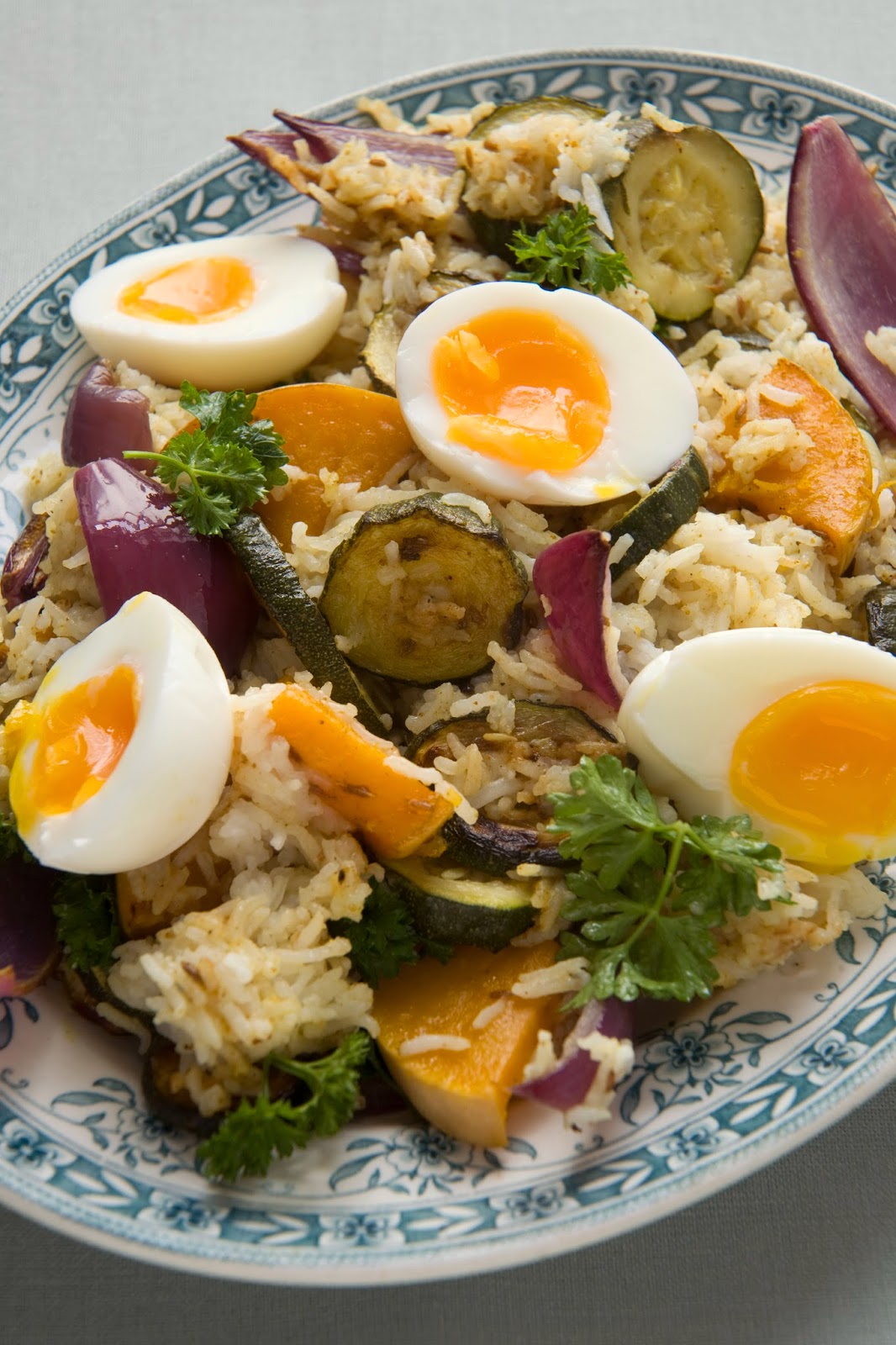 Serves 4
1 large red onion, peeled and cut into wedges
350 g butternut, deseeded and chopped
2 large courgettes, sliced
1 tsp cumin seeds
1 tsp curry powder
1 tbsp olive oil
300 g basmati rice
4 large eggs
handful parsley leaves
seasoning
- Preheat the oven to 200° (400°F) Gas mark 6.
- Place the onion, butternut and courgettes into a roasting tin. Sprinkle with the cumin seeds, curry powder and oil. Roast for 40 minutes, tossing a couple of times.
- Meanwhile, cook the rice according to the pack instructions.
- Softly boil the eggs.
- When the vegetables are cooked, drain the rice and stir into the roasting tin with the vegetables, along with the parsley. Season to taste.
- Carefully peel the eggs and serve cut in half on top of the dish.
Happy, stress-free eating.
Joy xx
Wednesday, 24 September 2014
Autumn Harvest

Last weekend was spent in lovely Wales, racing a yole double on the sea around the coast of Mumbles. Whilst racing the wild seas I could see the coast path winding it's way through bracken and over cliffs, then dipping down into beautiful white sandy bays with beach huts and ice-cream stalls - I had to walk this path!
So Sunday was spent on foot, strolling 20 miles along one of the nicest walks I have done in a long time. And there we came across absolutely millions of the best tasting blackberries ever (as well as sloes, but we ran out of space to carry those too!).
So for the past two days I have been making everything I can think of with blackberries - a good top up of vitamin C has been had I think! And these wonderful Paleo Blackberry Pancakes were breakfast this morning.
Paleo Blackberry Pancakes

Serves 2
1 banana, peeled
85 g ground almonds
10 g desiccated coconut
5 g sesame seeds
2 eggs
1 tbsp non-dairy milk
100 g blackberries
1 tbsp olive oil
2-3 tbsp honey or agave syrup
-Mash the banana in a large bowl.
-Stir in the ground almonds, desiccated coconut and sesame seeds.
-Beat the eggs and milk into the mixture.
-Lightly stir in 75 g of the blackberries.
-Heat the oil in a non-stick frying pan and spoon in two tablespoons of the mixture and cook for 3-4 minutes until golden underneath.
-Carefully flip the pancakes over and cook for 3-4 minutes on the other side until golden.
-Keep these warm then repeat the cooking process with the remaining batter.
-Serve scattered with the remaining blackberries and a drizzle of honey or agave syrup.
It's not too late to pick your own blackberries, get out to the countryside and do some foraging soon!
Joy x
Monday, 25 August 2014
Life can be sweet.

But that's the great thing about cooking, and loving to experiment with food and new ingredients - I get to make great desserts that are actually healthy, and can omit the ingredients that I prefer not to eat (wheat, dairy and too much sugar). I am constantly suggesting people avoid wheat and dairy for various health issues (bloating, flatulence, indigestion, constipation - sound familiar?), and the reaction is always the same - how can I possibly live without so much? Well you just need to change the way you think about foods and start playing. So yes, you really can have this amazing gluten and dairy-free chocolate cake!
The other thing I like to do is to find a product that I really love and then figure out how to make it myself - this normally means it will be tastier (as I can include my favourite ingredients) and will most certainly be cheaper.
This recipe came about after I tried Chia Pods - perfect little pots of dessert that are rich in omega 3 fatty acids, gluten and dairy free and contain only natural sugar. My recipe is obviously even tastier!
Orange and Mango Chia Puds

Serves 2-3
1 orange
1 mango, peeled and destoned
2 tbsp chia seeds
1 tbsp goji berries
2-3 tbsp non-dairy milk
- Grate the rind of the orange and then peel the orange and place the flesh into a food processor with the flesh of the mango.
- Process for a few seconds to break everything down.
- Add the grated orange rind, chia seeds, goji berries and milk and process again for 20-30 seconds, scrapping down any mixture that has escaped up the side of the bowl.
- Leave to stand for 5 minutes - this will allow the chia seeds to do their work - they expand and soften and turn everything to jelly!
- Blitz again one more time for a few seconds and then pour into bowls and serve, or place in the fridge for later.
Happy Eating!
J xx
Wednesday, 4 June 2014
Back to Paleo

I think a lot of the time people have forgotten what it feels like to be 100% well and full of energy, and you may not realise that some foods are affecting you. I have had a client recently who gave up gluten (I suggested this to her, as she was having some digestion problems), and she lost 4 cm around her waist, without losing any weight - she had been bloated from her intake of wheat that didn't agree with her, without her realising.
And this is what the Paleo diet is so good for - it cuts out all the man-made foods that may cause intolerances, and focuses on the nature-made foods that your body should recognise and know how to digest and extract nutrients from.
And the great thing about the Paleo diet is that you can maintain it for life. Infact I really don't like calling it a diet as this assumes you will 'go on' the diet and at some stage 'go off' the diet. If you can't maintain a new eating regime for at least 10 years (or life) then it's not really worth starting.
So what is Paleo? It's going back to the diet we think paleolithic man (cavemen) would have eaten - anything they could have caught or foraged for - grass-fed meat, wild fish, eggs, fresh fruit and vegetables. This means no grains, dairy, legumes or pulses (all of which may cause digestive problems).
Of course we are unlikely to go hunting and foraging, and buying all organic ingredients can be expensive, but every little bit you can do to aim to eat as naturally as possible is a step closer to a healthy you.
Today sees the launch of the Paleo aisle in Ocado's online store - with me as its' expert, so if you have any questions do get in touch.
Here is one of the recipes from my latest Paleo book -
Summer
Frittata
A great protein-rich meal that can be
served for breakfast, brunch or lunch, or could also be made to take on a
picnic or to work in a lunch-box.
Serves 4

Prep time: 16 minutes
Cooking time: 29-34 minutes
350 g sweet potato
2 tbsp olive oil
1 red onion, peeled and chopped
1 red pepper, deseeded and sliced
125 g fresh or frozen peas
1 tbsp chopped mint
1 tbsp snipped chives
seasoning
7 medium eggs
· Cook the sweet potato in a pan
of boiling water for 8 minutes, until just tender. Drain.
· Heat half the oil in a frying
pan and cook the onion with the sweet potato and red peppers for 5-6
minutes. Add the peas and cook for
one minute more.
· Beat the eggs in a large bowl,
pour in the vegetables and mix well.
Season and stir in the herbs.
· Heat the remaining oil in the
same frying pan and pour the egg and vegetables back into the pan. Preheat the grill to hot.
· Cook over a low heat for 15 -18
minutes, until the bottom of the tortilla is golden.
· Finish cooking under the grill
for 6-8 minutes, until golden on top.
· Leave the tortilla to stand for
a minute then run a knife around the edge of the pan, place a plate or board on
top and turn over to remove from the pan.
· Cut into wedges to serve.
Subscribe to:
Posts (Atom)